Which Identity and Residency Papers California Accepts for a License
A California license application can stall when the documents look reasonable but don’t meet the rule for the card you want. The key is to separate proof of identity from proof of California residency, then check how many documents your application requires and whether the names and addresses match.
Papers that can prove your identity
Identity documents establish who you are. A bill or bank statement with your name and address can help prove residency, but it does not normally replace an identity document. Keep those two jobs separate as you prepare.
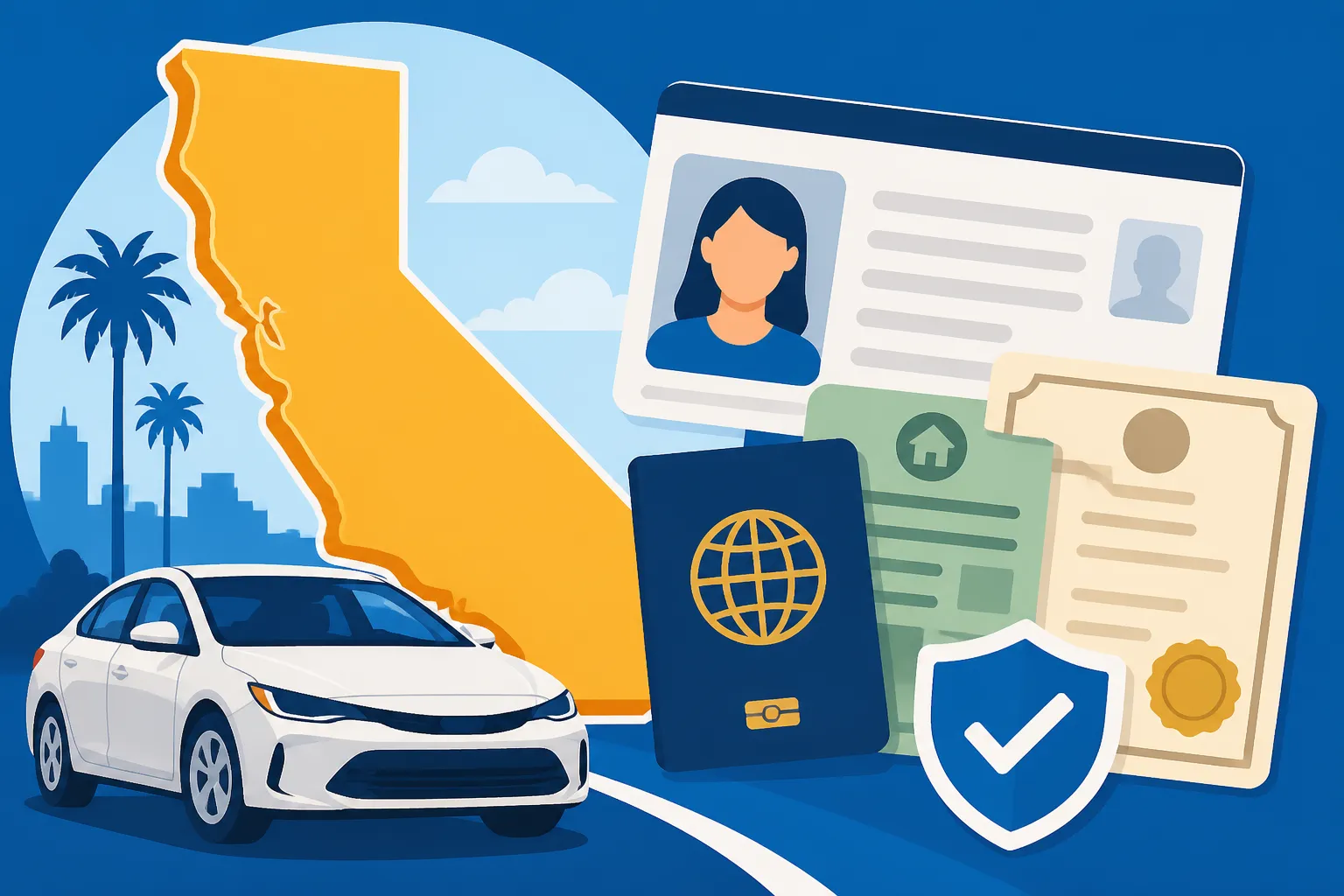
For a REAL ID, the California DMV asks applicants for an identity document from its accepted list. Common examples include:
- A valid U.S. passport or passport card
- A certified U.S. birth certificate
- A Certificate of Naturalization or Certificate of Citizenship
- A permanent resident card
- An employment authorization document
- Certain foreign passports and immigration documents
The document must meet the DMV’s requirements for that document type. Some documents have to be unexpired; others may be accepted under specific conditions. If you have an immigration document, for example, the DMV may need to verify its status or review accompanying records. Check the current California DMV list for your exact document before you rely on it.
A certified birth certificate is different from a hospital souvenir birth record or an uncertified photocopy. If you plan to use a birth certificate, make sure it is an official record issued by the relevant vital-records office. A passport can be a convenient alternative if it is current and acceptable for your application. For a closer comparison, see Birth Certificate or Passport? Identity Proof for a California REAL ID.
The document should identify you clearly and consistently. If your current legal name differs from the name on your identity document, bring the records that connect the two names. Depending on your situation, that might include a marriage certificate, a court order, or another official name-change record. A sequence of documents may be necessary if you have changed your name more than once.
Some documents can establish a name change but not serve as your primary identity document. For instance, a marriage record may explain why your name differs from your birth certificate, but it does not automatically take the place of the identity document required for the card. Prepare both parts of the proof: the qualifying identity document and the records that explain any name difference.
Before your visit, compare the name on each record character by character. Pay attention to middle names, suffixes, hyphens, spacing, and spelling. A small difference may be explainable, but it is better to identify it in advance than to discover at the counter that you need another record. Name or Address Doesn’t Match? Fixing California REAL ID Paperwork covers common mismatches and the documents that may help resolve them.
What is not usually enough by itself
A Social Security card, school ID, employee badge, library card, or utility bill may be useful for another part of an application, but do not assume it is accepted as the required primary identity document for a REAL ID. The DMV’s accepted-document list determines what qualifies. Similarly, a photocopy or phone photo of an identity document may not be enough when the DMV requires an original or certified document.
If you are applying for a standard card rather than a REAL ID, the documents you need may differ. Do not assume that a document accepted for one card type automatically satisfies the other. Check the requirements for the specific application you are completing, as explained in REAL ID or Standard Card: Which Should You Pick in California?.
Papers that can prove California residency
Residency documents show that you live in California at the address you provide. For a REAL ID, applicants generally need two acceptable documents showing California residency. Each should display your name and a California residential address, and the information should be current and consistent with your application.
Common examples of documents that may qualify include:
- A utility bill
- A rental or lease agreement
- A mortgage bill or statement
- A bank or other financial statement
- An insurance document
- A tax document
- An employment document
- A school record
- A medical or health-related document
- A vehicle registration or title
- Certain government-issued correspondence
This is a practical list of examples, not a guarantee that every document in a category will qualify. The DMV’s current list and document rules control. A statement might fail if it is missing your name, shows only a mailing address, or does not meet the requirements for the document type.
For example, a utility bill that lists only a roommate’s name may not prove your residency on its own. A document addressed to you at a post office box may not establish the physical California address the application asks for. A lease can be helpful, but check that it identifies you as a tenant and includes the relevant address and dates.
A pair of documents should also make sense together. If one shows an old address and the other shows your current one, the DMV may need a clearer record of where you live now. Using two recent documents that show the same California residential address can reduce avoidable questions.
Do not assume that two copies of the same document count as two proofs. Nor should you assume that a document is acceptable simply because it displays an address. Review the DMV’s examples and conditions for your card type. Does Your Utility Bill Count? California Residency Proof Questions explains why the details on a bill matter.
Documents for someone who lives with you
People who live with family, a partner, or a roommate may have few bills or contracts in their own name. That can make residency proof harder, but it does not mean you should use another person’s document as if it were yours.
Check the DMV’s current instructions for applicants whose household documents are in someone else’s name. A parent, guardian, spouse, or other household member may be able to provide information or documentation under the applicable process, but the relationship and supporting records can matter. If a minor’s residency proof is involved, the minor’s own name and address requirements are especially important; see Residency Documents Must Carry the Minor’s Name and Mailing Address.
Bring records that clearly show the relationship when the DMV’s instructions call for them. A birth certificate, for example, may help connect a minor to a parent, but it does not by itself turn the parent’s utility bill into a document in the minor’s name. Confirm the current rules before traveling to an office.
If you recently moved, your records may not all have caught up. Update accounts where appropriate, then use documents that show your current California address. If you cannot obtain conventional bills or lease papers, review the full range of accepted evidence rather than guessing which substitutes will be allowed. The DMV may accept particular alternatives, but the category and format matter.
Your document set depends on the card you want
A California standard license and a REAL ID license are not the same document choice. Both are driver’s licenses, but their document requirements differ. A REAL ID requires the identity and residency evidence specified for that card, along with the other information the application asks for. A standard card may have different documentation requirements and does not serve as a REAL ID for federal identification purposes.
Use this comparison as a planning tool, then verify your individual requirements with the California DMV:
| Document or requirement | REAL ID application | Standard license application |
|---|---|---|
| Identity evidence | An accepted identity document is required | Identity requirements depend on the applicant and application |
| California residency evidence | Generally, two acceptable residency documents | Requirements may differ; confirm the current list |
| Social Security number | Required for REAL ID applications, subject to DMV verification | Requirements can differ by applicant and license pathway |
| Immigration or lawful-status evidence | Required document rules depend on the applicant’s status and document type | Requirements depend on the license pathway |
| Federal identification use | A REAL ID card can meet federal REAL ID requirements | A standard card is not a REAL ID |
The table is not a substitute for checking the precise application instructions. Applicants may have different circumstances, such as a name change, a pending Social Security card, immigration documents, or a license issued by another state. The DMV may also require additional evidence to resolve a mismatch or verify a record.
If you are unsure whether you need a REAL ID, consider what you will use your license for beyond driving. A standard license may be the better fit if you already use another federally accepted document for identification. The choice is personal, but your paperwork should match the card you select. REAL ID in California: Who Needs One and How to Get It explains the card’s purpose and application steps.
Applicants who cannot provide the documents required for a REAL ID may still have another license pathway. California’s AB 60 license is for eligible applicants who cannot provide proof of lawful presence but can meet the program’s identity and California residency requirements. It is a driver’s license, not a REAL ID, and its application has specific document rules. Review AB 60 License: Proof of Identity and California Residency and the DMV’s current AB 60 instructions before assembling your papers.
If your Social Security number has not arrived, do not substitute a different number or leave information to chance. Requirements differ by application and license type. Review Applying for a California License While Your SSN Is Still Pending or No Social Security Number? How the AB 60 License Works in California if either situation applies to you.
Handle name changes, address differences, and unusual records
A document set can be valid in isolation and still raise questions when the records do not line up. The most useful preparation is to find the mismatch before submitting your application and bring the official records that explain it.
Your legal name changed
Start with the identity document you plan to use, then trace how its name connects to your current legal name. If the names differ, bring the official name-change record or records that explain the difference. Make sure the documents cover every transition if you have had multiple name changes.
A marriage certificate, court order, or other official record may help, depending on why the name changed. A personal explanation or an informal document is not a substitute for the record the DMV requires. Check the DMV’s current guidance for the kind of name change involved.
Your documents show different addresses
An old address on a document does not necessarily make the document useless, but it may not work as proof of your current residence. Choose documents that show your current California residential address whenever possible. If you moved recently and only some records have been updated, be prepared to explain the timeline and confirm whether the DMV accepts the documents you have.
The address on your application should be accurate. Do not enter a different address just to make it match an old bill. If a mailing address differs from where you live, check how the application handles those separate fields and which address the residency proof must show.
For drivers who recently relocated, Moving to California: Getting Your Driver’s License Sorted can help put the license process in context. If you are still figuring out when California considers you a resident, see What Counts as Establishing Residency in California Before You Drive.
Your record is foreign or not in English
Foreign identity and immigration documents may be acceptable in some circumstances, but the specific document, validity, and supporting evidence matter. Do not assume that every national identity card, passport, visa, or translated record qualifies. Check the DMV’s current requirements for the exact document you hold.
If a document is not in English, ask what translation or verification the DMV requires before your visit. A translation may help the DMV interpret a record, but it does not change whether the underlying document is an accepted form of proof. Keep the original document available if the DMV requires it.
Your documents are electronic
A downloaded statement or electronic bill can be convenient, but electronic availability does not automatically make a record acceptable. Check whether the DMV accepts a printout or digital document for the specific proof you plan to use. Make sure the version includes all relevant details, such as your full name, California address, issuer, and date.
Screenshots can omit account-holder information or other details. When possible, print or download the complete statement rather than relying on a cropped phone image. Do not alter a document to make it appear more current or to change the address.
Prepare for the DMV visit
A short document check before you leave can save a second trip. The best approach is to identify your card type, follow the official requirements for your situation, and arrange your records in a way that makes each document’s purpose clear.
- Choose the card type. Decide whether you are applying for a standard license, a REAL ID, or an AB 60 license. Requirements vary.
- Review the current DMV document list. Check the identity and residency sections for that exact application. Look for special instructions about expiration, originals, certified copies, translations, or supporting records.
- Make a document checklist. Write down which paper proves identity, which papers prove residency, and which records explain name changes or other differences.
- Compare names and addresses. Check spelling, middle names, suffixes, and whether the residency documents show your current California residential address.
- Gather original or certified records when required. A photocopy may help you organize your papers, but it may not replace an original or certified document.
- Complete any online application steps. An online application can help prepare for an office visit, but it does not necessarily eliminate the need to show documents in person. Keep any confirmation information the DMV provides.
- Find an office and confirm current details. Use the official California DMV office locator to find an office and check its current hours and services. Do not rely on an old schedule or assume every office handles every application.
If you are completing a first application, the identity and residency records are only part of the process. You may also need to meet testing or other application requirements. For the broader sequence, see California Driver’s License Basics: Apply, Renew, Replace.
If your documents are not straightforward, verify the exact requirements before your visit rather than bringing a large stack of unrelated papers. A clear set of accepted records is usually more useful than many documents that do not prove the required facts. If you cannot tell whether a document qualifies, consult the California DMV’s current instructions or contact the agency through its official channels before you go.
Frequently Asked Questions
Do I need two residency documents for every California license?
Not necessarily. Two acceptable California residency documents are generally required for a REAL ID. Requirements for a standard license or another application pathway may differ. Check the current California DMV instructions for the card you are applying for.
Can I use a utility bill as proof of residency?
A utility bill may qualify if it meets the DMV’s current requirements and shows the information required, including your name and California address. A bill in another household member’s name or one showing only a mailing address may not be enough by itself.
Can a passport prove both identity and residency?
A passport can be an identity document, but it does not show that you live at a California address. You generally need separate residency evidence when the application requires it.
Can I use a photocopy of my birth certificate?
Do not assume a photocopy will be accepted. When using a birth certificate as identity evidence, confirm that it is an official certified record in an acceptable format. Check the DMV’s current instructions before your visit.
What if my documents show different names?
Bring the official records that connect the names, such as the applicable marriage record or court order, and check the DMV’s guidance for your situation. The exact documents needed depend on the reason for the difference.
Disclaimer
This article is for general informational purposes only and does not constitute professional advice. Laws, prices and regulations vary by location and change over time. Consult a qualified professional for guidance on your specific situation. California Driver Guide is not a government agency and is not affiliated with any state motor vehicle department.