New to California? Apply for a License Rather Than Renew
Moving to California can make a familiar license task confusing: should you renew your old card or apply for a California one? If you have an out-of-state license, the usual route is a new California application, not a renewal. Here’s how to tell which process fits, what to prepare, and what may happen at a DMV office.
Why a new California resident usually applies
A license renewal extends a California driver’s license that is already eligible for renewal. It is not the process for transferring a license issued by another state or country. If you move to California and intend to establish residency, you generally need to apply for a California license rather than renew your out-of-state card.
The distinction matters because a new application can involve identity and residency documents, an in-person visit, a vision screening, and a knowledge test. Renewal requirements are different and may depend on your age, record, and renewal notice. Starting with the wrong application can mean lost time or an incomplete visit.
The general rule is straightforward:
- You have a license from another state or country and are becoming a California resident: Start a California license application.
- You already have a California license that is expiring: Check the renewal process and your notice.
- Your out-of-state license is expired: You may still need a new California application, but expect the circumstances to affect which tests or steps apply.
- You have never held a license: You are applying for your first California license, with requirements based on your age and driving history.
If you are uncertain whether California considers you a resident yet, review What Counts as Establishing Residency in California Before You Drive. The practical deadline is tied to residency, not simply the day you unpack or change your mailing address. For a broader overview of newcomer tasks, see Moving to California: Getting Your Driver’s License Sorted.
Check your situation before choosing an application
Before you begin, identify the license you currently hold and whether it is valid. These details help determine whether you are transferring an existing driving privilege, starting from the beginning, or dealing with an expired or suspended license.
| Your situation | Likely starting point | What to keep in mind |
|---|---|---|
| Valid license from another U.S. state | New California license application | A driving test may be waived in some cases, but do not assume every test is waived. |
| Valid license from another country | New California license application | You may need to complete California knowledge and behind-the-wheel testing. |
| Expired out-of-state license | New California license application | Test requirements may depend on how long it has been expired and your record. |
| Suspended or revoked out-of-state license | Resolve the status before driving or applying | California may not issue a license while a suspension or revocation remains active. |
| Existing California license nearing expiration | California renewal process | This is the situation in which a renewal application may fit. |
| No previous license | First-time California application | Age-specific permit, education, or testing rules may apply. |
This table is a starting point, not a final eligibility decision. The California DMV determines the requirements for your application. If your old license is suspended, revoked, or subject to a restriction, do not treat a move as a reset. Read Moved Here With a Suspended Out-of-State License: What to Expect before driving or applying.
A valid out-of-state license is also different from an expired one. A current license may help establish your driving history and could affect whether a road test is required. An expired license can lead to additional testing or documentation. The details can depend on the license type, your driving record, and the information California can verify. For a focused explanation of expired cards, see California License After an Expired Out-of-State One: Where to Start.
Moving from another country adds another layer. An international driving permit is not a California license, and carrying one does not turn a foreign license into a California renewal. Check the current California requirements for your specific license and status, and avoid assuming that rules for a license from another U.S. state also apply to an overseas license.
Keep the application separate from REAL ID
A California driver’s license can be standard or REAL ID. REAL ID is a card option, not a separate kind of driving test or a different license-transfer process. When applying, you can decide whether you want to request REAL ID and provide the documents required for that card.
If you do not need a REAL ID, you can ask about a standard card instead. Compare the options in REAL ID or Standard Card: Which Should You Pick in California?. If you choose REAL ID, make sure your identity and residency documents meet the current requirements. A document that works for one type of card or application may not satisfy every REAL ID requirement.
Do not choose a renewal option simply because you want a REAL ID. If you do not already have a California license, you still need to use the new-license application route. The card choice comes within that process.
Gather documents for identity, residency, and your current license
Documents are one of the most common reasons a newcomer’s office visit takes longer than expected. Make a checklist based on your exact situation before you go. The California DMV’s current document list is the final reference, because acceptable documents can depend on whether you are applying for a standard card or REAL ID and on your legal name and status.
Plan to verify these categories:
- Identity and date of birth: Bring an eligible identity document. If your name has changed, confirm whether you need documents connecting the name on your identity record to the name you want on the California card.
- California residency: Check whether your application requires proof of your California residence and which documents are accepted for your card choice. Make sure the name and address on your documents match your application as closely as possible.
- Social Security information: Follow the instructions for your application and status. If your Social Security number is pending or you do not have one, use the guidance that applies to your circumstances rather than guessing what to enter.
- Current or recent license: Bring your out-of-state license if you have it. If it is expired, damaged, or unavailable, check what other information or documents the DMV asks for.
- Name-change documents, if relevant: Bring official supporting records if your current name differs from the identity documents you present.
- Application confirmation: If you start the application online, save the confirmation code and bring it with you.
For a more detailed document checklist, see Transferring a License From Another State: Documents to Have Ready and Which Identity and Residency Papers California Accepts for a License. If you have a name mismatch, it is worth sorting that out before the appointment; Name or Address Doesn’t Match? Fixing California REAL ID Paperwork explains common document issues.
Be especially careful with residency evidence. A document may show where you receive mail without meeting the DMV’s requirements for proving California residence. Confirm that the document type, name, and address fit the current rules. If you are applying for REAL ID, review its specific document standards rather than relying on a general list for a standard license.
If your Social Security card is still in the mail, do not assume you must wait or that you can skip information requested by the application. The correct steps depend on your situation. See Applying for a California License While Your SSN Card Is in the Mail for related questions.
Keep originals and copies organized separately. When an application calls for original documents, a phone photo or photocopy may not be enough. Make sure documents are readable and not expired when the DMV requires a current document. If you are unsure whether a paper qualifies, use the official California DMV document guidance before your visit.
Start the application and plan for an office visit
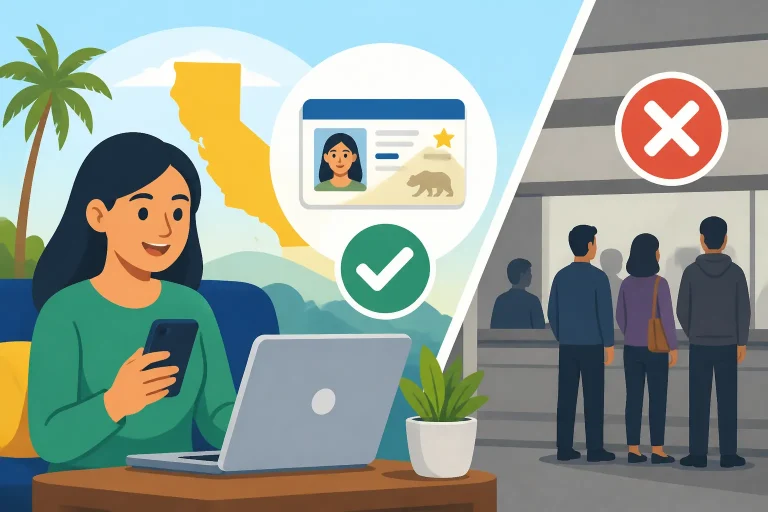
Many applicants can begin the process online, but starting online does not necessarily complete the application. A new California license application commonly requires an in-person visit so the DMV can verify documents, take a photo, check your vision, and complete other required steps. The online portion can help you enter information ahead of time and save a confirmation code.
Use this sequence to avoid treating the online form as the whole process:
- Choose the new-license application. Do not select a renewal route if you do not already have a California license that qualifies for renewal.
- Decide whether to request a standard or REAL ID card. Compare the document requirements before choosing.
- Complete the online application if available for your situation. Enter your information carefully, especially your legal name and address.
- Save the confirmation code. Keep it somewhere you can access during the office visit. If you lose it, check the application instructions for ways to recover or locate it.
- Review the current document checklist. Gather the identity, residency, and other records that apply to your application.
- Check whether you need an appointment. Use the California DMV’s official appointment information and office locator to plan the visit and confirm current hours.
- Bring your documents and current license. Arrive ready for document review and any required screening or test.
For an explanation of what online preparation does and does not accomplish, see Starting a License Application Online: How Long It Takes on Average. A completed online form is not the same thing as a California license, and it does not guarantee that every requirement has been met.
At the office, expect the DMV to review your application and documents. You may need to provide a signature, have your photo taken, complete a vision screening, and provide a thumbprint. The exact sequence and required steps can vary. If staff identify a missing or inconsistent document, ask what needs to be corrected before leaving so you know whether you can continue that day or need to return.
Do not plan your visit based only on a general estimate of how long it takes. Service time, testing, and document review can vary. Check the official office locator for the nearest field office and its current hours, and use the California DMV’s own appointment information to confirm whether an appointment is available or needed for your service.
What the tests may involve
Applicants transferring a valid out-of-state license may be exempt from a behind-the-wheel test in some circumstances. That does not mean every applicant is automatically exempt. The DMV determines whether your experience and license qualify for a waiver. Applicants with a foreign license, an expired license, or a more complex driving history may face different requirements.
A knowledge test may also be required. Do not assume that holding a license elsewhere means you can skip every California test. Review Moving to California: Will You Face the Written Knowledge Test? for the questions newcomers commonly ask, then confirm your own requirements with the California DMV.
If a test is required, study the California Driver’s Handbook and focus on California rules that may differ from the rules where you previously drove. A practice test can help you identify topics to review, but it should supplement—not replace—the handbook. For a step-by-step study approach, see How to Study for the California DMV Permit Test.
If you are told that a behind-the-wheel test is required, confirm what vehicle and documents you must bring and whether a separate appointment is needed. The vehicle must meet the DMV’s requirements for a drive test. Arriving with an unsuitable vehicle can mean the test cannot proceed, even if your paperwork is complete.
Understand timing, driving privileges, and common delays
California’s new-resident deadline is based on when you establish residency. The commonly stated deadline is short, so do not wait until your out-of-state license is close to expiring to start planning. Check the California DMV’s current guidance for the applicable deadline and circumstances. Moving to California: How Soon Must You Switch Your License? covers how the timing question connects to residency.
While preparing, keep your existing driving privilege in mind. A move does not make an expired, suspended, or revoked license valid. If your current license is valid, do not assume it will let you drive in California indefinitely after you become a resident. Follow the state’s resident requirements and confirm what applies to your situation. If you are unsure whether you may drive while an application is pending, ask the California DMV before getting behind the wheel.
After completing the required steps, the DMV may issue a temporary document while your card is produced and mailed. Follow the instructions on that document, including any limits or expiration information. If the card does not arrive when expected, use the California DMV’s official status service or contact options rather than submitting a duplicate application without checking. A second application can complicate an already active request.
Common delays include:
- The wrong application type: A renewal form does not transfer an out-of-state license.
- Missing or unsuitable documents: A document may not prove identity or residency as required.
- Name differences: A mismatch between an application and supporting records can require extra proof.
- A lost confirmation code: Keep the code available if you begin online.
- Unclear license status: An expired or suspended license can change the steps.
- Assuming a test is waived: Waivers depend on the applicant and the license being transferred.
- Choosing REAL ID without the required papers: A standard card and REAL ID have different document expectations.
- Waiting until the last minute: A test, missing record, or appointment availability can extend the process.
If you do not have a Social Security number, California’s AB 60 license process may be relevant, depending on your eligibility and circumstances. It is not a renewal shortcut; it is a distinct route with its own application and document requirements. See No Social Security Number? How the AB 60 License Works in California and verify the current requirements directly with the California DMV.
Cost is another point to check before starting. The amount depends on the type of application and any tests or other steps required, and figures can change. Use the California DMV’s official fee information for current amounts rather than relying on an old estimate. What a California License Costs: Where to Check Before You Pay explains where the cost fits into planning.
A practical newcomer checklist
Use this checklist before you begin:
- Confirm that you are applying as a new California resident rather than renewing an existing California license.
- Check your current license status, expiration date, restrictions, and any suspension or revocation.
- Review the deadline that applies once you establish California residency.
- Decide whether you want a standard card or REAL ID.
- Check the current identity and California residency document requirements for that card.
- Gather your out-of-state or foreign license and any name-change records that apply.
- Complete the online application if it is available and suitable for you.
- Save the confirmation code and any application receipt.
- Review whether a knowledge test or drive test may be required.
- Find the nearest DMV office through the official office locator and check current hours.
- Confirm appointment and testing instructions through the California DMV.
- Keep any temporary driving document and follow its conditions while you wait for the card.
If you already hold a California license that has expired, do not automatically follow the new-resident process. Your history may make renewal or another route appropriate. Compare your situation with California Driver’s License Renewal Guide for Every Situation. If the license you hold is from another state, the more relevant starting point is Moving to California: Getting Your Driver’s License Sorted.
The key is to separate two questions: Are you renewing a California license, or applying for a California license for the first time? For most people moving from another state or country, the answer is a new application. Once you choose that route, confirming documents and testing requirements before the office visit can prevent avoidable delays.
Frequently Asked Questions
Can I renew my out-of-state license after moving to California?
No. A California renewal is for an eligible California license. If you are establishing residency in California with a license from another state or country, you generally apply for a California license.
Will I have to take a road test?
Not necessarily. Some applicants transferring a valid license from another state may qualify for a waiver, but the DMV decides based on the individual application. Foreign, expired, or otherwise complicated license situations can have different requirements.
Do I need REAL ID to get a California license?
No. REAL ID is an option, not a requirement for obtaining a California driver’s license. Choose the card type that suits your needs and prepare the documents for that option.
Can I drive while I wait for my California card?
Follow the conditions on any temporary document the DMV issues and do not drive if your existing license is expired, suspended, or revoked. If you are unsure whether your current license permits you to drive during the transition, confirm with the California DMV.
Disclaimer
This article is for general informational purposes only and does not constitute professional advice. Laws, prices and regulations vary by location and change over time. Consult a qualified professional for guidance on your specific situation. California Driver Guide is not a government agency and is not affiliated with any state motor vehicle department.