Swapping a Senior’s Driver’s License for an ID Card: What to Bring
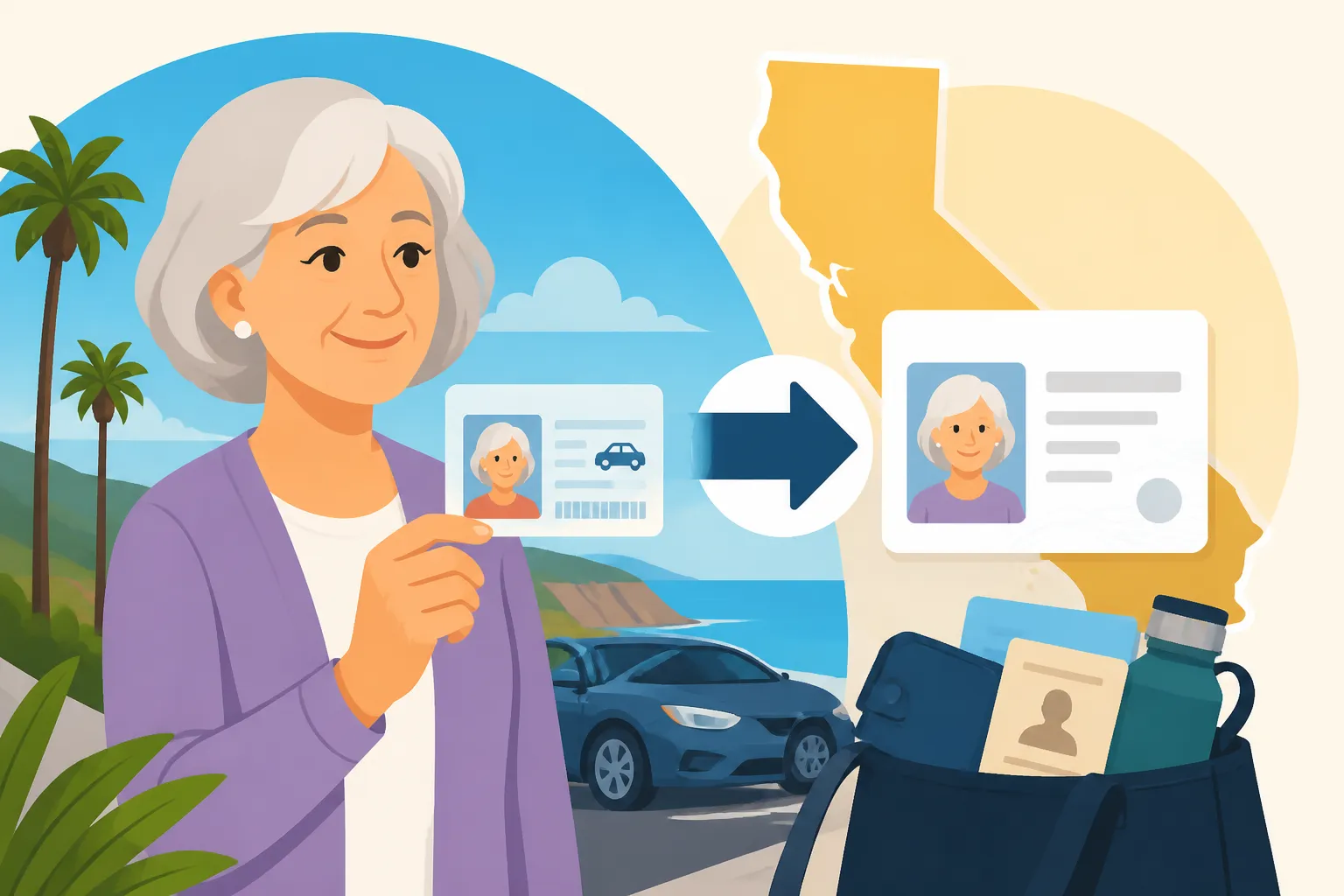
If you’re ready to stop driving but still need photo identification, exchanging a California driver’s license for an ID card can feel like a simple switch—with a few important paperwork questions. The key is to know what the California DMV requires, whether you need proof of residency, and how to prepare before contacting the agency so you can avoid a trip with missing documents.
What to bring when exchanging a California license for an ID card
The California Department of Motor Vehicles says a senior exchanging a California license for an ID card must complete an ID application, provide a Social Security number, and verify identity with an acceptable identity document. Proof of California residency is required only if you have never had a California DL/ID.
The DMV information supplied for this article is dated November 2026. According to the California Department of Motor Vehicles, seniors 62 or older qualify for a no-fee Senior ID card.
That is the essential checklist, but it helps to prepare each item deliberately. The application, Social Security number, and identity document serve different purposes; having one does not automatically replace another.
Complete the ID application
An ID application is part of the exchange, even though you already have a California driver’s license. Before you begin, look for the current application instructions from the DMV and follow them for an ID card rather than assuming that a license renewal or replacement process is the right one.
If you start the application online, keep any confirmation details the system provides. An online application may prepare information for the agency, but do not assume it completes every required step. Follow the DMV’s directions for any remaining identity verification or in-person work, and bring your confirmation information if the agency tells you to.
If you prefer to prepare before choosing a service method, California ID Cards: Eligibility, Fees and How to Apply explains the broader ID-card process. For a senior who already has a license, the important point is to identify the request as an exchange to an ID card, not as a routine license renewal.
Provide your Social Security number
The DMV says to provide your Social Security number. That means you should be ready to give the number through the method the DMV specifies. Do not assume that a Social Security card is necessarily the required document just because the application asks for the number; the fact that the number must be provided and the requirement to prove identity are separate parts of the checklist.
If you are unsure what to enter, or whether a document is needed to support the number, check the current instructions with the California Department of Motor Vehicles before your visit. Avoid sending personal information through an unofficial service or an email address you have not verified through the agency.
Verify your identity with an acceptable document
The DMV requires an acceptable identity document. The word acceptable matters: not every document that includes your name or photograph will necessarily meet the agency’s rules for this application. Use the DMV’s current list to confirm that the document you plan to bring is accepted and that it fits your situation.
Check that the document is the correct version and is in usable condition. If your name differs across documents, or if an identity document is unavailable, do not rely on a guess about which alternatives the agency will accept. Ask the DMV how to proceed before you go.
The identity-document requirement is separate from proof of California residency. A document may establish identity without serving as residency evidence, and a residency document may not meet the identity requirement. For a closer look at identity-document questions in California, see Which Identity and Residency Papers California Accepts for a License. Use the DMV’s current ID-card guidance to confirm which specific documents apply to your exchange.
Decide whether you need proof of California residency
According to the California Department of Motor Vehicles, proof of California residency is required only if you have never had a California DL/ID. If you currently hold a California driver’s license, that fact points to an existing California DL record, so do not assume you must gather new residency documents just because you are changing the type of card.
If you have never had a California DL/ID, prepare to show the residency proof the DMV accepts. If you are unsure how your history fits the rule—for example, if you had an older California card but no longer have it—ask the DMV before the visit rather than deciding based only on the physical card in your wallet.
For more on how the agency treats residency evidence, Does Your Utility Bill Count? California Residency Proof Questions can help you think through common document questions. It is still the DMV’s current requirements that determine what to bring for your application.
Check whether the Senior ID card applies
The no-fee Senior ID card is tied to the age eligibility stated by the DMV, not simply to the fact that someone is retiring from driving. If you meet that eligibility, make sure you are applying for the Senior ID option rather than assuming every ID-card request will be handled the same way.
If you do not meet the stated age eligibility, do not assume the no-fee option applies. The cost of an ID card can depend on the card type and situation, and the DMV’s current information is the place to verify any amount. The fact that a senior exchange may qualify for a no-fee card does not establish that every related service, replacement, or special card request is free.
For a broader explanation of the available card types and how to apply, see Getting a California ID Card Without a Driver’s License. That article covers a different starting point, but it can help clarify the role of an ID card if you are comparing your options.
Make the decision before you give up driving privileges
Exchanging a driver’s license for an ID card is more than a paperwork change. A driver’s license authorizes driving, while an ID card serves as identification. Before you request the switch, consider whether you are ready to stop driving and whether keeping a license would still be useful to you.
An ID card may be the right choice if you no longer drive and want an official identification card. But if you expect to drive again, even occasionally, clarify the consequences of changing your credential before completing the exchange. Do not assume that getting a license back later will be as simple as requesting a replacement card; the process may depend on your circumstances and the DMV’s current rules.
The DMV’s ID-card guidance identifies what a senior must provide for the exchange. It does not, by itself, answer every personal question about when to stop driving, how a license is handled during the exchange, or what steps would apply if you later wanted driving privileges again. Confirm those points directly with the agency before making a decision.
Think about what you use your license for
A driver’s license often serves as everyday photo identification even when the holder drives infrequently. Before exchanging it, make a list of situations where you currently show it, such as handling financial or medical matters, completing identity checks, or accessing services. Then consider whether an ID card will meet your needs in those situations.
Do not assume every organization accepts every card in exactly the same way. If a particular institution has its own identification rules, ask it what it accepts. The DMV issues the credential, but it does not determine every private organization’s verification process.
If you are deciding between keeping a license and holding an ID card, California ID Card vs Driver’s License: What Each Lets You Do offers a side-by-side explanation. You can also read Keeping Your License but Wanting a Regular ID Card Too if your goal is to retain driving privileges while exploring a separate identification card.
Consider card type and future identification needs
Some applicants may need to consider whether they want a standard ID card or a REAL ID-compliant card. Do not choose based only on what another person has or on the appearance of the card. Think about how you expect to use it, then review the DMV’s current requirements for the card type you want.
A standard card and a REAL ID card may involve different documentation considerations. The core exchange checklist in this article does not describe every document needed for every card type, so confirm the exact requirements before you make a trip. For help comparing the options, read REAL ID or Standard Card: Which Should You Pick in California?.
If you already have a REAL ID driver’s license, ask the DMV whether that affects the application or documents for your requested ID card. Do not assume your current status automatically carries over to a different credential.
Talk with family or a trusted adviser if the choice is difficult
A family member can help organize paperwork or accompany you, but the decision to exchange the license should reflect your own plans and needs. If someone is helping, make sure you understand what the application requests and that personal information is handled carefully.
If the question is whether it is safe for you to continue driving, that is separate from the ID-card application. Consider discussing driving ability with a qualified healthcare professional or another appropriate adviser. The DMV’s paperwork checklist cannot evaluate whether driving is right for a particular person.
Prepare your documents and plan the DMV contact
A little organization can make the exchange easier, especially if you are helping a parent or relative. Keep the required items together, verify the current instructions, and leave time to resolve any uncertainty before you go.
Use a practical preparation sequence
- Confirm that you want an ID card rather than a license renewal or replacement. If your goal is to stop driving and hold an ID card instead, use the DMV’s ID-card exchange instructions.
- Review the current ID application directions. Complete the application in the way the DMV specifies, and save any confirmation details if you begin online.
- Prepare to provide your Social Security number. Follow the agency’s instructions for when and how to provide it.
- Choose an acceptable identity document. Check the DMV’s current list rather than relying on a document merely because it has your name or photograph.
- Determine whether residency proof applies. The DMV says it is required only if you have never had a California DL/ID. If that describes you, identify acceptable residency documents using the current DMV instructions.
- Check whether you qualify for a no-fee Senior ID card. The DMV says seniors 62 or older qualify. Confirm that you are selecting the appropriate card type and ask about any other charges that may apply to your circumstances.
- Check the service method and office instructions. If the DMV directs you to visit an office, use the official office locator to find a nearby location and its current hours. Check whether an appointment or other preparation is needed before you travel.
This sequence is a planning aid, not a substitute for the DMV’s application instructions. The agency’s current requirements control if they differ from a checklist you have saved or received from someone else.
Keep originals and copies in perspective
Do not decide on your own that a photocopy, phone image, or scanned file will satisfy an identity-document requirement. The facts for this exchange say to verify identity with an acceptable identity document, but they do not specify which format the DMV will accept in every situation. Check the agency’s current instructions about what to bring and whether an original document is needed.
If you have uploaded documents as part of an online process, do not assume that upload removes the need to bring a document to an office. Follow the instructions shown by the DMV for your particular application. A confirmation code or upload receipt can be useful for reference, but it is not necessarily a replacement for the document itself.
Handle name differences before the visit
Look at the names on your application and identity document before you go. If they do not match, pause and check the DMV’s current guidance. A difference may be due to a name change, a spelling issue, or an older document, but the right way to resolve it depends on the documents and circumstances involved.
Bring any documents the DMV specifically requests to connect the names, and avoid relying on an informal explanation as a substitute for required evidence. If you are not sure what evidence is needed, contact the agency before leaving home. For name-change issues in the California licensing context, Changing Your Name on a California License or ID Card is a useful related resource.
Get help without handing over control of personal information
If a relative is assisting, they can help read instructions, organize documents, or accompany you if appropriate. Still, protect your Social Security number and identity documents. Share sensitive information only through the official DMV application or other verified process the agency directs you to use.
A helper should not guess at answers on your behalf or submit information without your understanding and permission. If you have difficulty with an application, ask the DMV what assistance or accessible service options are available. You can also review California ID Cards: Eligibility, Fees and How to Apply for the general process, then verify the exchange-specific details with the agency.
What to expect from the exchange and what to verify
The required items are straightforward, but the practical details can depend on how you apply and what card you request. The safest approach is to distinguish what the DMV says is required from what you still need to confirm for your case.
| Item or question | What the DMV guidance says | What to do before you go |
|---|---|---|
| ID application | Complete an ID application | Follow the current ID-card application instructions |
| Social Security number | Provide your Social Security number | Check the approved method for providing it |
| Identity document | Verify identity with an acceptable identity document | Confirm that your chosen document is accepted |
| California residency proof | Required only if you have never had a California DL/ID | If applicable, confirm which proof the DMV accepts |
| Senior ID eligibility | Seniors 62 or older qualify for a no-fee Senior ID card | Confirm that the Senior ID option fits your application |
| Office or online steps | The exchange guidance does not settle every service detail | Check the DMV’s current instructions for your situation |
The table summarizes the available exchange requirements; it does not promise that a particular application method is available or that no additional step will apply. Check the DMV’s instructions for your exact card and circumstances.
Confirm how the existing license is handled
Before you complete the exchange, ask the DMV what happens to the driver’s license and when you should stop using it. Do not assume that the license remains valid for driving after you request an ID card, or that it must be surrendered at a particular point. The agency can confirm the process that applies to your application.
If you have a planned trip or need identification during a transition period, ask how long a new card may take and what, if anything, you can use while waiting. Do not rely on an estimated mailing time from an unrelated application or from another person’s experience.
For general information about a California license and its usual services, California Driver’s License Basics: Apply, Renew, Replace may help distinguish a license renewal or replacement from an ID-card exchange. The DMV remains the source for the timing and handling of your specific request.
Check whether a visit is necessary
Some DMV tasks can be started or completed online, while others require agency staff to verify documents or finish the transaction. The exchange information alone does not establish which steps you can complete remotely. Follow the current instructions for the application, and do not make a trip based solely on an assumption that an online submission finished the process.
If the DMV requires an office visit, use its official office locator to find a nearby office and check current hours. Check appointment instructions and any service-specific directions through the agency before traveling. This can prevent arriving at a location that cannot handle the transaction or arriving without required paperwork.
For details about planning an office visit to switch a license to an ID card, see Visiting a DMV Office to Switch Your License to an ID Card. It is especially useful if you are helping a senior organize the visit and want to separate preparation tasks from what the agency must handle.
Ask the DMV focused questions
If anything is unclear, prepare a short list of questions before contacting the agency. For example:
- Does my previous California driver’s license record mean I do not need residency proof?
- Is the identity document I plan to bring acceptable for this application?
- Do I need to bring an original document, or will another format work?
- Can I begin the application online, and what must still be done with the DMV?
- How will my current driver’s license be handled during the exchange?
- Does the no-fee Senior ID option apply to the card I am requesting?
- Is an appointment needed for the service I need?
These questions are meant to help you get clear answers, not to add requirements. The agency can tell you which documents and steps apply based on your record and requested card.
Common mistakes that can delay an ID-card exchange
The most avoidable problems usually come from treating the exchange like a routine renewal, mixing up identity and residency evidence, or relying on an outdated checklist.
Assuming the old license means no application is needed
An existing license does not remove the ID application requirement. The DMV specifically says to complete an ID application for the senior exchange. Start with the correct process rather than expecting the agency to convert the card automatically when you stop driving.
Bringing a document without checking whether it is acceptable
A passport, birth certificate, or other document may seem like an obvious choice, but use the DMV’s accepted-document guidance to confirm. The requirement is an acceptable identity document, not merely a document that appears useful. If your name or other details differ, check what supporting evidence the DMV requires.
Gathering residency documents when they may not be necessary
Residency proof is not required for every senior exchange. The DMV says it is required only if you have never had a California DL/ID. Check your California card history before collecting paperwork, and ask the agency if you are uncertain whether a past credential counts.
Assuming every senior gets the same card at no cost
The no-fee rule is specific: the DMV says seniors 62 or older qualify for a no-fee Senior ID card. Do not apply that statement to every ID card, age group, replacement request, or related service. Verify the card type and any other possible charges with the DMV.
Believing an online start completes everything
Online application steps can be useful, but follow the DMV’s instructions about any remaining verification or office visit. Save confirmation details and bring them if directed. Do not leave necessary identity documents at home just because you entered information online.
Making the change before considering future driving
If you may want to drive again, ask the DMV what would be required after the exchange. The ID-card checklist does not answer how a future return to driving would work. Make the decision with a clear understanding of what the card change means for your plans.
Frequently Asked Questions
Does a senior need proof of California residency to exchange a license for an ID card?
The California Department of Motor Vehicles says proof of California residency is required only if you have never had a California DL/ID. If you are uncertain about your record, confirm it with the DMV before your application.
What does a senior need to bring for the exchange?
The DMV says to complete an ID application, provide your Social Security number, and verify your identity with an acceptable identity document. Residency proof is conditional, as described above.
Is the Senior ID card free?
According to the California Department of Motor Vehicles, seniors 62 or older qualify for a no-fee Senior ID card. Confirm with the DMV that this is the card option that applies to your request.
Can I complete the exchange online?
The exchange requirements do not establish that every step can be completed online. Follow the California DMV’s current instructions for your application and complete any remaining steps with the agency.
Should I exchange my license if I might drive again?
Consider your plans before giving up driving privileges. Ask the DMV what happens to your license during the exchange and what steps would apply if you later wanted to drive again.
Sources
- Department of Motor Vehicles — ID Cards (checked November 11, 2026)
Disclaimer
This article is for general informational purposes only and does not constitute professional advice. Laws, prices and regulations vary by location and change over time. Consult a qualified professional for guidance on your specific situation. California Driver Guide is not a government agency and is not affiliated with any state motor vehicle department.