No Social Security Number? How the AB 60 License Works in California
Not having a Social Security number can make a California license application feel like a dead end. For some California residents, an AB 60 license provides a way to qualify for driving privileges without proving lawful presence in the United States. The key is understanding who this license is for, which documents to prepare, and what it does—and does not—allow you to do.
What an AB 60 license is—and what it is not
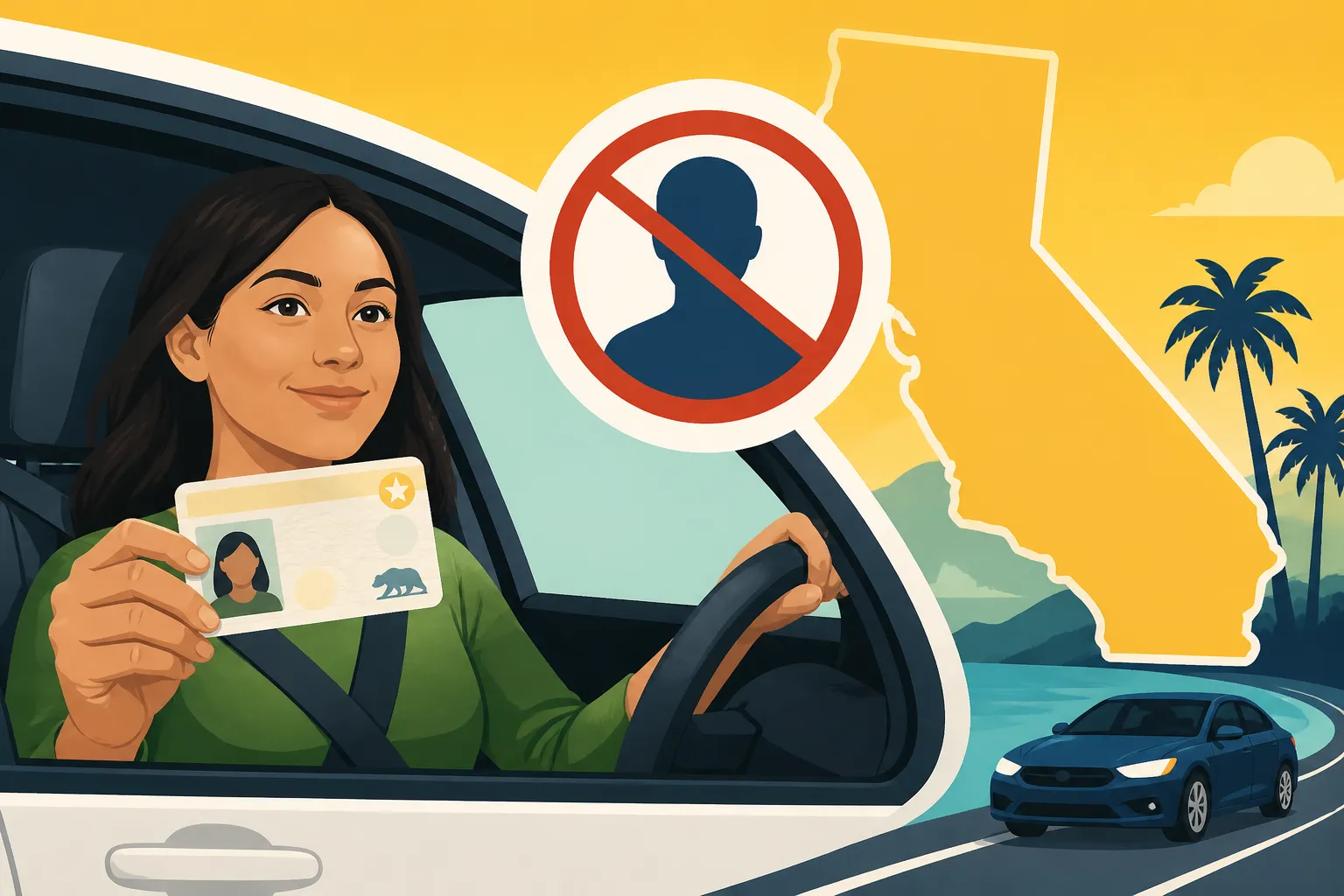
California’s AB 60 program allows a person who cannot provide proof of lawful presence in the United States to apply for a driver’s license if they meet the other requirements. The license authorizes driving in California, just like other California driver’s licenses. It does not grant immigration status, work authorization, or permission to vote.
Not having an SSN does not, by itself, make someone eligible for an AB 60 license. The program is for people who cannot provide the required proof of lawful presence. Conversely, a person’s lack of an SSN does not necessarily mean AB 60 is the right application route: someone waiting for an SSN or who has another qualifying immigration status may need a different process. If your SSN is in the mail, see Applying for a California License While Your SSN Is Still Pending.
An AB 60 license is not a REAL ID. It cannot be used as federal identification for purposes such as boarding a federally regulated domestic flight or entering certain federal facilities. A card marked “Federal Limits Apply” is not a substitute for checking the identification rules of an airline or facility. For a comparison of card types, read REAL ID or Standard Card: Which Should You Pick in California?
| Question | AB 60 license |
|---|---|
| Who may apply? | A California resident who cannot provide proof of lawful presence and meets the other licensing requirements |
| Is an SSN the basis for eligibility? | No. AB 60 eligibility is based on inability to provide proof of lawful presence, not simply on having no SSN |
| Does it allow driving in California? | Yes, once the license is issued |
| Is it a REAL ID? | No |
| Does it grant immigration or work status? | No |
| Can it be used for every purpose that accepts ID? | No. Acceptance depends on the specific organization and purpose |
The exact steps and evidence depend on your situation, age, and driving history. The California Department of Motor Vehicles (DMV) is the authority that decides whether an application and its documents meet current requirements. For the basic eligibility rules, start with Who Can Apply for an AB 60 License in California?
Who may qualify and what the SSN question means
The central AB 60 requirement is that an applicant cannot provide proof of lawful presence in the United States. Applicants must also meet California’s regular licensing requirements, including proving identity and California residency, completing the required tests, and paying applicable fees. If you are unsure whether your situation fits the program, compare the general criteria in California Driver’s License Eligibility: Who Can Apply with the AB 60-specific rules, then confirm your route with the DMV.
An SSN and proof of lawful presence are different things. An SSN is a number used for Social Security and other administrative purposes; it does not establish that a person qualifies for an AB 60 license. Likewise, an ITIN is not an SSN and should not be entered as one. Do not borrow another person’s number, guess, or give information you know is inaccurate. If a form or DMV employee asks about your SSN and you are uncertain what applies to you, ask the DMV how to answer truthfully for your circumstances.
The distinctions can be useful in common situations:
- You cannot provide proof of lawful presence and do not have an SSN. You may be able to apply through AB 60 if you meet the program’s other requirements.
- You have an SSN but cannot provide proof of lawful presence. Having the number does not automatically rule you in or out. AB 60 eligibility depends on the lawful-presence requirement and the rest of your application.
- You are eligible for an SSN but have not received it yet. Do not assume AB 60 is the right alternative. Check whether you can proceed with the regular application process or need to wait; Applying for a California License While Your SSN Is Still Pending covers that situation.
- You have never been eligible for an SSN. Explain that accurately when asked and confirm what the DMV requires for your application. Do not use an ITIN in the SSN field.
An AB 60 license does not depend on a particular nationality or language. Applicants still have to establish their identity and California residency using documents the DMV accepts. Those requirements can be the most time-consuming part of preparation, especially if names, dates, or spellings differ between records.
Before choosing an application path, make sure you are applying as a California resident. A person who has recently moved may have a different set of licensing steps. The broader overview in California Driver’s License Basics: Apply, Renew, Replace can help distinguish a first California application from a renewal or replacement.
Documents to prepare before applying
For an AB 60 application, expect to prove who you are and that you live in California. The DMV maintains the current document requirements, and the exact documents that work depend on the applicant’s circumstances. Do not assume a document will be accepted just because it is official or was accepted by another organization.
The DMV provides lists of acceptable identity and residency evidence. Use its current guidance to select documents that match your situation, then review AB 60 License: Proof of Identity and California Residency and Which Identity and Residency Papers California Accepts for a License for practical ways to think through the paperwork.
Identity evidence
Identity documents need to connect the applicant to a recognizable name and personal record. Depending on the case, the DMV may accept certain foreign-issued identity documents, but acceptance depends on the specific document and whether it meets the DMV’s criteria. A document that is expired, difficult to verify, or inconsistent with other records may require additional review.
Before your visit, check each document for:
- The name and date of birth, and whether they match the application.
- Expiration dates and whether the document is in a format the DMV accepts.
- Differences in spelling, order of names, or use of multiple surnames.
- Whether a translation or other supporting record is required.
- Whether the DMV requires the original rather than a copy.
If your records show different versions of your name, do not wait until the counter to find out whether that will cause a problem. Gather supporting documents that explain the difference and check the DMV’s current instructions. A mismatch does not necessarily mean you cannot apply, but it can slow down verification.
California residency evidence
The DMV also needs acceptable proof that you live in California. A mailing address alone may not answer every residency question, and not every bill or piece of mail qualifies as evidence. Check the current residency document list and make sure the records show the required information in a format the DMV accepts.
If you share a home or do not have bills in your own name, the right documents may take extra planning. Do not assume that someone else’s proof automatically counts as yours. Ask the DMV what supporting evidence is permitted for your circumstances. The questions in Does Your Utility Bill Count? California Residency Proof Questions may also help you identify what to verify before you apply.
Keep the paperwork consistent
Create a simple folder with your original documents and a separate set of copies for your own reference. Copies can help you track what you brought, but they do not replace originals if the DMV requires originals for verification. Keep your application confirmation information with the folder if you start the process online.
Check that the information you enter on the application matches your documents. If a document is not in English, if a name differs, or if you are unsure how a particular record is treated, check the DMV’s requirements before making assumptions. A short verification step can prevent a second trip.
How to apply and complete the required tests
An AB 60 application follows the general process for getting a California driver’s license, with additional attention to verifying identity and residency. The DMV makes the final decision on the application. A typical first-time process looks like this:
- Review the current AB 60 instructions. Confirm that the program fits your situation and check the DMV’s up-to-date document list, application steps, and testing requirements.
- Complete the application. Follow the DMV’s instructions for starting or completing the application. Save any confirmation number or other application information provided.
- Visit a DMV office as directed. Bring the required original documents. The DMV may need to review your paperwork in person, take your photo, and complete other application steps. Find the nearest office and its current hours with the official DMV office locator.
- Complete the vision and knowledge requirements. The DMV will tell you which tests you need. Study the California Driver’s Handbook and review the current testing instructions. Taking the Written Test for a New California License explains how to prepare for the knowledge test.
- Get a permit if required before practicing. A permit is not a license to drive alone. Follow the permit’s supervision and other restrictions every time you practice.
- Pass the behind-the-wheel test if required. Check the DMV’s vehicle and appointment requirements. If you use your own vehicle, it must meet the DMV’s conditions for a drive test.
- Pay the applicable fee and follow the DMV’s instructions. Fees and procedures can change, so confirm current details with the DMV rather than relying on an old notice or informal estimate.
- Wait for the license to be issued. Do not drive on the assumption that an application, test pass, or appointment confirmation is itself a valid license.
Applicants under 18 have additional requirements, such as rules about driver education, supervised practice, and provisional driving. These requirements do not disappear because the application is through AB 60. Teens and their parents or guardians should review California Teen License Application: Permit to Provisional Card before planning the application.
The knowledge test checks understanding of California driving rules, signs, and safe driving practices. Read the official handbook rather than relying only on practice questions. Practice resources, including a course from I Drive Safely, may help reinforce material, but they do not replace the DMV handbook or the DMV’s actual test requirements. If you need a particular language or an accommodation, ask the DMV what options are available before test day.
For the driving test, make sure you understand the permit rules, bring a suitable vehicle, and follow the DMV’s instructions about insurance and vehicle documents. Use Preparing for Your California Behind-the-Wheel Test Near You to plan your practice and test-day checklist.
Driving privileges, limits, and common mistakes
An AB 60 license is a California driving credential. Once issued, it lets the holder drive according to the license class and any restrictions on the card. It does not turn an application receipt, test result, or learner’s permit into permission to drive without the required supervision.
The most important limits to keep in mind are:
- It is not federal identification. Do not rely on an AB 60 card for a federal identification purpose. Confirm directly with an airline, federal facility, or other organization what documents it accepts.
- It does not change immigration status. Receiving a driver’s license does not grant lawful presence, citizenship, work authorization, or a right to vote.
- It does not guarantee acceptance for every other use. A business, school, bank, or government office may have its own identification rules. Ask the organization whether it accepts the card for the specific transaction.
- It does not remove ordinary driving responsibilities. The driver must follow traffic laws, keep the license current, and meet requirements such as financial responsibility for a vehicle.
- It does not replace a permit’s restrictions. If you have only a learner’s permit, follow its supervision and practice rules.
Several mistakes can make the process harder than it needs to be. One is treating “no SSN” as the entire eligibility test. Another is bringing documents without checking whether the DMV accepts them for the purpose you need. A third is driving before the appropriate license or permit privilege is in effect. A fourth is assuming that a license card can be used as REAL ID or for any federal purpose.
If the DMV cannot verify a document or asks you to provide more information, get clear instructions on what is missing and how to resolve it. Keep any written notices, application details, and receipts together. If a decision or delay is unclear, contact the DMV through its official channels and describe the specific issue rather than submitting a duplicate application without checking first.
Frequently Asked Questions
Can I get an AB 60 license if I do not have an SSN?
Possibly, but having no SSN does not by itself qualify you. AB 60 is for California residents who cannot provide proof of lawful presence and who meet the other licensing requirements. Confirm which application path applies to your situation with the DMV.
Can I use an ITIN instead of an SSN?
No. An ITIN is not an SSN. Do not enter an ITIN or another person’s number as your SSN. If you are unsure how to answer the SSN question, ask the DMV.
Can I drive while my AB 60 application is being processed?
An application in progress does not authorize solo driving. You may drive only when you have the appropriate valid license or permit and comply with its conditions, including any required supervision.
Is an AB 60 license a REAL ID?
No. An AB 60 license is not a REAL ID and cannot be relied on for federal identification purposes. Check the identification requirements for the particular airline, facility, or transaction.
Does an AB 60 license change my immigration status?
No. It provides California driving privileges when issued, but it does not grant immigration status, work authorization, citizenship, or voting rights.
Disclaimer
This article is for general informational purposes only and does not constitute professional advice. Laws, prices and regulations vary by location and change over time. Consult a qualified professional for guidance on your specific situation. California Driver Guide is not a government agency and is not affiliated with any state motor vehicle department.